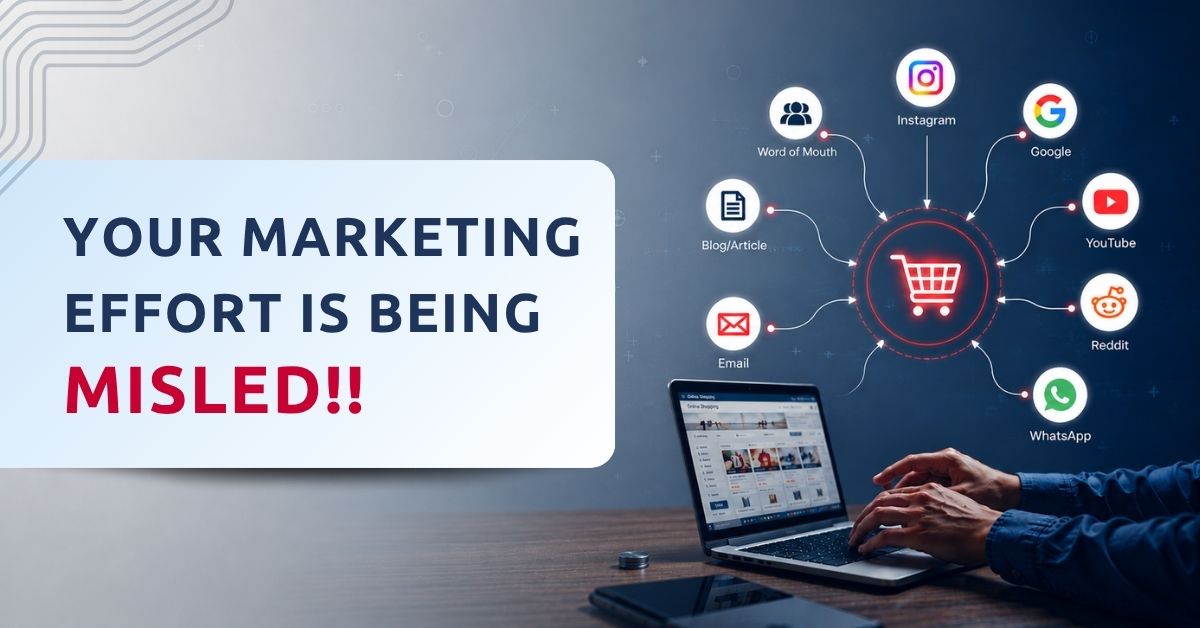
Most marketers are making million-dollar decisions based on a measurement model that was designed for a world that no longer exists: last-click attribution.
Last-click attribution is a model that gives all the credit for a conversion to the final touchpoint a customer interacts with before making a purchase. It’s the equivalent of giving the match-winning trophy to the player who scored the last goal while ignoring everyone who passed the ball, made crucial tackles, or created the opportunity in the first place.
Especially in a world where we’ve already discussed how Gen Z doesn’t follow a straight path to purchase, this model no longer reflects reality. Consumers move through multiple touchpoints, revisit brands several times, and make decisions through what often feels like an infinite loop. Measuring only the final interaction means ignoring most of the journey that actually influenced the purchase.
How Last-Click Attribution Became the Standard
Let’s go back to the basics.
When digital marketing exploded, its biggest advantage was that almost everything was trackable. For nearly two decades, marketers could confidently prove ROI because every click, impression, and conversion could be measured.
The click became the currency of accountability, and that’s where last-click attribution found its place. Whoever earned the final click before the purchase received all the credit.
At the time, it felt scientific. It felt fair.
In reality, it was neither.
Why Last-Click Attribution Is Broken
Think about it this way.
Using last-click attribution is like crediting the delivery executive for making the sale while completely ignoring the Instagram Reel that sparked interest, the YouTube review that built trust, and the WhatsApp message that finally convinced someone to buy.
Every one of those touchpoints influenced the purchase. Yet only one receives the credit.
A Real Customer Journey in 2026
This is what a typical Gen Z buying journey looks like today.
At 11:00 p.m., someone watches a Reel from a creator.
They don’t click on it.
The next morning, they search for the brand on Google.
Later, they come across a Reddit thread discussing the product and read a few reviews.
A few days later, a friend shares a WhatsApp discount link.
Only then do they click and complete the purchase.
With last-click attribution, the entire sale is credited to the WhatsApp link.
But what about the Instagram Reel that created awareness? The Google search that showed intent? The Reddit reviews that built trust?
Those touchpoints didn’t disappear. They simply became invisible to your measurement model.
The Cost of Measuring the Wrong Things
This is exactly why attributing success to the wrong touchpoint can become dangerous for a brand.
Brands often start cutting investments at the top of the funnel because those activities don’t generate direct conversions. Awareness campaigns, brand films, creator collaborations, and PR are usually the first to lose budget, even though they’re often responsible for starting the customer’s journey.
The result is a performance marketing death spiral.
Your Customer Acquisition Cost (CAC) keeps increasing because you’ve reduced your organic and brand-building efforts, forcing performance marketing to work even harder to compensate. Instead of lowering acquisition costs, you’re making every future customer more expensive to acquire.
When your brand stops appearing organically and people only discover you through paid campaigns, every rupee you stop spending immediately reduces your visibility. Eventually, new audiences won’t even know your brand exists unless you pay to reach them.
What Better Marketing Measurement Looks Like in 2026
If last-click attribution is no longer enough, what should marketers be measuring instead?
Instead of relying entirely on last-click attribution, start incorporating brand lift studies to understand how campaigns influence awareness and perception beyond direct conversions.
Don’t overlook UTM parameters. While they won’t capture every private or “dark social” share, they remain one of the simplest ways to better understand where your traffic is actually coming from.
Move beyond a 30-day attribution window and start looking at 90 to 180-day customer journey mapping. Modern buyers rarely make decisions after a single interaction, so your measurement model shouldn’t assume they do.
Use incrementality testing wherever possible. Temporarily pause a marketing channel, measure the impact, and evaluate what actually changes. The difference tells you what that channel was contributing, even if it wasn’t receiving direct attribution.
At the checkout stage, simply ask customers, “How did you hear about us?” It may sound old-school, but it’s still one of the most reliable ways to uncover influences that analytics platforms often miss, especially in Indian e-commerce.
Finally, pay attention to brand search volume. If people are searching for your brand by name, it’s often a strong indicator that your awareness efforts are working, even if those campaigns aren’t generating immediate conversions.
The Question Every Marketer Should Ask
Before planning your next marketing budget, map your last major campaign and list every touchpoint your customer interacted with before converting.
Then ask yourself:
Which of these touchpoints are we actually measuring?
More importantly,
Which ones have become invisible simply because our attribution model doesn’t give them credit?
And here’s the biggest question of all:
If you turned off every marketing channel that doesn’t generate direct conversions today, how much of your business would disappear in the next 90 days?
The answer to that question will tell you whether you’re measuring your marketing accurately, or simply rewarding the last click.